
Welcome to our August 2025 e-News!

Minster Musings
How do we know the will of God? The Creator who created roughly eleven thousand species of birds, over thirteen billion light-years of stars and a myriad of flowers, landscapes and people. It’s extraordinary that we can know anything of God, and that God could be interested in us at all. Yet Christian teaching and experience throughout the ages bears witness to the fact that we can hear the voice of God; that God cares for us with extraordinary extravagance even in the minutiae of our lives.
Sometimes we are lucky enough that we hear God speak loud and clear, like the Apostle Paul on the road to Damascus, or Peter when God sent him the dream of eating unclean animals to prompt him to go and share the good news of Christ with the Gentiles. These moments are rare gifts of clarity. For my own part there have a been a few times where God has spoken directly to my heart and mind. Once when standing behind an altar in a friend’s church hearing the words ‘this is where you belong’ and being moved to tears. Another when discerning where I would serve my counselling placement- the minute I heard of Noah’s Ark I knew that was where I would go. Looking back, it was clear, these things I heard and felt were the clear voice of God, but at the time I was definitely not so sure. Just because I felt or thought something strongly wasn’t evidence enough that I had heard the voice of God. We are all capable of self-deception and mistakes, our minds and hearts can play tricks on us. We can fool ourselves into thinking our thoughts and feelings are aligned with God’s when they may simply be our own responses strongly felt.
Ignatius of Loyola the founder of the Jesuit order wrote and thought much about discernment, how to discern the will of God for our lives and our actions. So much so he developed the Ignatian spiritual exercises. These were either to be completed over 30 days in retreat or alternatively there is an adapted version to undertake in daily life. They involve spending much time with God, in prayer, in visualisations, and in scripture. One of the things Ignatius identifies is that in discernment there are spirits and primarily two, the spirit of consolation and the spirit of desolation. In consolation we are moving in alignment with God’s will, in desolation we are not. He says that we know consolation and desolation by their fruits, if we are in a state of consolation things may be hard or difficult or painful, but the fruits of the spirit are there, love peace, community prayerfulness, hope etc. If we are in a state of desolation then we may have some fleeting feelings of happiness but as a general trend we become increasingly internalised, negative, self-obsessed, isolated, unable to see the way markers of God in our lives and drained of energy. In short consolation brings life, and desolation death. In the exercises Ignatius teaches us to spend time with God, to spot the trends and patterns, and from that learn to discern the will of God.

Discernment takes time, it’s a journey, and an art. Like learning to read the weather, play music or create art it takes practice, and it’s with watchful reflection that we spot our mistakes and hone our skills. If we make a decision and aren’t sure if it’s the right one, time will show us. Over time we will see if it bears fruits of consolation or desolation, and we can respond accordingly. God doesn’t expect perfection from us, its ok if it takes time for us to tune in, like a radio that can’t quite find the signal. What matters is that we have an ear on the sound and hand on the dial ready to adjust and respond, ready to hear the beautiful music of God for our lives and the lives of others. Ready to hold the dial fast when we find it, so that we may rest in the will of God for our lives, rest in the love of God which transforms us and radiates out to all around us, helping them to hear the music too.
Revd Sam Crook
Curate
In memory of John Hardy

John was a large man with a very large life. John was a family man, married to Janet with two children, Andrew and Alison, both of whom have their own families, providing John not only with grandchildren, but also great grandchildren too. John was a man of faith and worshipped in the Minster for over 50 years, serving as Church Warden under three Vicars, for 20 years. Family and faith were the most important things in John’s life. John and Janet ran a newsagent shop here in Halifax and became well known across the town. John had a strong sense of public service and wanted to try to make the world a better place, motivated by his faith. He was a School Governor for many years – often as Chair; was a local Councillor and served as Mayor of Calderdale; a political agent for the Conservative Party; a Rotarian, the Chair of West Yorkshire Scouting Association; a member of the Greater Churches National Executive and had many other roles in his time. In describing John’s personality, one would have to refer to his humour, and his loyalty. He once proposed something at a PCC meeting that he didn’t necessarily agree with, but he knew that it was something important to me, as given that he and Ann Coldwell had just supported my nomination to the Crown, he wanted to back me out of pure loyalty. That demonstrates the nature of John, and his willingness to embrace change, even when he was unsure. His support for the rededication of Halifax Parish Church to becoming Halifax Minster was immense, and he influenced the whole town and borough, in jumping for joy when it came. The last 18 months have been a struggle for John, and now he returns home to the loving God who gave him to us. May he rest in peace and rise in glory. John’s Funeral will be on Friday 22nd August at 1.30pm in the Minster. We send our love to Janet, Alison and Andrew, and the whole family.
Canon Hilary Barber
Vicar of Halifax
The Friends of the Minster
The Friends of Halifax Minster was established to support the fabric of this ancient grade 1 listed building. The Friends have raised thousands of pounds over the years to help keep the building in good repair and enable people living locally and far away to make a financial contribution. The Friends can belong through subscription or by leaving a legacy in their wills, to help secure the Minster’s future. In recent years, The Friends have helped to provide much needed match funding to the Minster Council, helping us draw down other money from other charitable organisations, and providing additional money when a project reveals something hidden and unexpected. In recent years they have helped to pay for repair work in the tower, the new collection box, the reordering at the front of the Nave, the high level stone replacement at the East End, the new Paschal (Easter) Candle stand, repairs to the Organ, and now some money towards the repairs to fabric in the Minster, so that we can have a Low Mass Set for use midweek, alongside the High Mass Sets by Graeme Willson we use on Sundays. The Friends are also very practical, they volunteer as Welcomers, provide afternoon teas and guided tours throughout the summer, and provide refreshments throughout the Heritage Festival. Representatives of the Friends sit on the Minster Development Board, working alongside the Minster Council and the Halifax 900 Trust, as we plan for the future and look to share our time, skills, and financial resources. The Friends annual meeting takes place on Sunday 5th October at 12.30pm after the morning service. Why not consider joining the Friends and include the Minster in your Will and play your part in securing the future of this wonderful sacred place and common ground for future generations.
Canon Hilary Barber
Chair of the Friends of Halifax Minster
July in the Minster
July has been a month of two halves with the busyness of the start of the month, with the close of the Summer Festival and the concert season giving way to the relative calm of the school summer holidays.
Highlights of the end of the 2025 Summer Festival featured the Ars Musica Male Voice Choir from Erfurt, Germany; the Interstellar 10 concert and the Halifax Choral Society’s production of Carmina Burana.
In July the Minster also hosted three school’s concerts, Adele and Whitney Houston tribute nights, both to full houses and the moving performance of the Beloved Son, the story of Henri Nouwen.
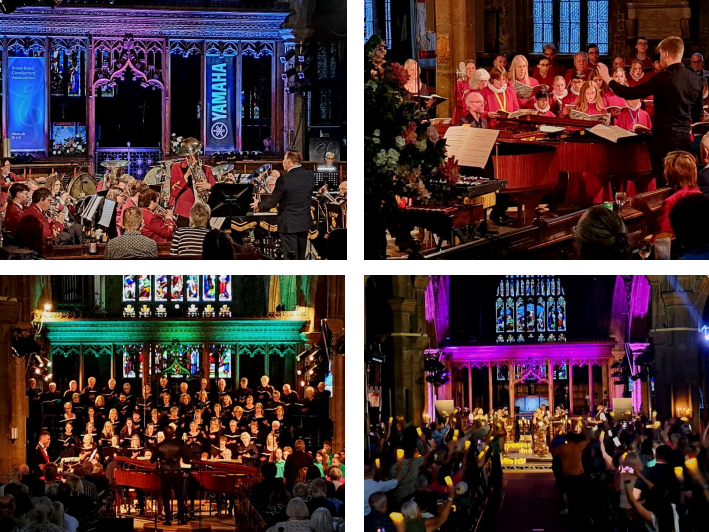
August at the Minster

The Friends of the Minster are serving Afternoon Teas each Saturday and there are also Guided Tours at 2pm. To book, please contact the Minster Office or on the website.
The weekly Thursday @ One Organ Recitals continue with buffet lunches from 12.15pm.
The choir tour to Southwell Minster is over the last weekend of the month, before term begins again in September.
Parishioner Profile
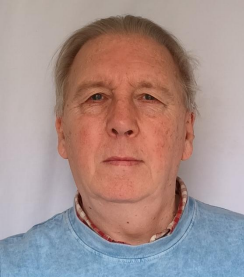
Name: Kevin Maddy
Favourite music: Blue – the colour of a clear sky, of cornflowers, gentians and Syrian hibiscus.
Favourite music: Late romantic – Mahler, Strauss, Schoenberg – and early opera. However, I like all kinds of music, including jazz and soul.
Favourite place: Many – Rome, Paris, Washington DC, Bermuda, Singapore, Yokohama and …
Favourite food: Lebanese and Syrian.
Thing most proud of: My family – Diana, Christopher and Chantelle – and our working Cocker Spaniel ‘Pearl’
Work life: Retired Parish Priest with recently acquired Permission to Officiate in this diocese.
100-word bio: I was born and raised in Halifax and attended Crossley & Porter Grammar School. Whilst at music college in Manchester, where I studied trumpet and piano, I received the call to ministry. I trained for the priesthood at Selwyn College and Westcott House in Cambridge and then served my curacy in Broadstairs in Kent. For almost twenty years I served as a military chaplain with the RAF and army, with tours in the Netherlands, Cyprus and Iraq, after which I was Port Chaplain and Rector of Yokohama Christ Church in Japan for just over four years. In 2011 we returned to UK, and I was briefly vicar of two parishes in Barnsley before becoming Rector of St Stephen’s Canterbury and chaplain to the Archbishop’s School, as well as Area Dean of Canterbury, before retiring at the end of 2023.


