
Minster Musings

December has come around once again, and I’ve just been reminded to get a move on with the e-news for the month. The Minster is filling up with visitors eager to view the Christmas trees, and the hot water heater in our kitchen area has just decided to have a permanent rest, so, nothing original this month, I fear. Rather, I came across an article entitled ‘Virgin Mary, Meek and Mild?’ written by Dr. Susan Elliot who is involved with the Westar Institute, home of the Jesus Seminar. You can Google it if you like but be prepared for some radical theology. Anyway, ‘Virgin Mary, Meek and Mild?’ What do you think?
“Christmas is coming and with it the many images of the Virgin Mary, Meek and Mild.
In the time before COVID, there were Christmas pageants. A little girl or a young teen might kneel demurely at the manger if she is cooperating, blue shawl over her head, opposite the boy in the bathrobe as Joseph, standing firm. They form the manger scene. Sweet and angelic Mary gazes on the baby Jesus.
Or we may think of Christmas cards with images of Mary in pale blue, gazing downward, hands in a posture of prayer.
Or we may recall works of art we have seen, statues and stained glass in church buildings and museums.
Mary, hands folded in prayer or Mary holding the infant Jesus, appears as devout, meek and mild, an image of womanly perfection.
The beatific Mary of these images appears as silent in the still beauty of the Christmas night.
Is Mary silent, however, or silenced?
This image of Mary the mother of Jesus bears no resemblance to the image presented by the author of the gospel of Luke. In the opening narratives of the gospel, Luke carefully constructs a contrast between Zechariah, the father of John the Baptist, and Mary, the mother of Jesus.
Each receives a divine messenger, later identified as Gabriel, who announces the birth of their child. Both are surprised, Zechariah because he and his wife, Elizabeth, are old and beyond the childbearing years, Mary because she is a virgin.
Each responds differently, however, and the outcome is different for each.
The parallel narratives in Luke 1 follow a form found in Hebrew scriptures when a leader or prophet receives a divine call. The gospel author clearly follows the sequence of elements that Norman Habel discerned in those narratives to present a telling contrast.
Each account begins with an introduction to the character. Zechariah and his wife, Elizabeth, are presented as virtuous individuals from good family lineages. Zechariah is a priest, and the scene opens in the sanctuary of the temple as he is fulfilling his service.
The description of Mary’s location is terse in contrast, and her location is described simply as “a town in Galilee called Nazareth.” Her lineage is not mentioned, but she is betrothed to “a man named Joseph of the house of David.”
The action begins in each with the first element of the form, a divine confrontation. A divine messenger appears to Zechariah in the temple and he shakes with fear.
The divine messenger who appears to Mary is named as Gabriel.
The messenger speaks to each of them using phrases characteristic of call narratives in elements of the form labelled the “introductory word” and the “commission.” Language familiar from birth announcements in the Hebrew scriptures is also incorporated.
The messenger assures Zechariah with the characteristic “Don’t be afraid” and gives him the news that his prayer is heard, that Elizabeth will bear a son. The messenger instructs him to name the child “John” and tells of the important mission John will have.
Gabriel’s greeting to Mary is one that often indicates that a call to a mission will follow, “Greetings, favoured one! The Lord is with you!”
The narrative then portrays her contemplating the nature of the greeting. Then the divine messenger explains her commission, beginning with the assurance “Don’t be afraid.” He tells her that her mission is to conceive and give birth to a son and name him Jesus. Jesus is announced as the one who will rule forever on the throne of David.
As is typical in call narratives, the one called objects. Zechariah asks how he can be sure of what Gabriel has said since he and his wife are both old.
Mary asks how this can happen when she has not known a man.
In each case, the messenger responds with a sign, a usual element in call narratives.
Because he did not trust the divine messenger’s words, Zechariah is struck dumb, unable to speak until the events are fulfilled and he later delivers a prophetic speech after the naming of his newborn son, John.
This narrative concludes with a description of Zechariah unable to speak and instead adds a response from his pregnant wife, Elizabeth, that indicates that the Lord has taken away her disgrace.
For Mary, the divine messenger explains that she will conceive by the holy spirit and the sign is Elizabeth’s pregnancy now six months along. Mary responds with an affirmation of her enslavement to the Lord and the prayer that the messenger’s message be fulfilled.
Zechariah, the temple priest, is silenced while Mary, called to conceive and bear the son of the Most High, speaks her assent to carrying out her assigned mission.
In the next scene, Mary really speaks. Proceeding immediately to the house of Zechariah in a city in the hill country of Judah, she greets the pregnant Elizabeth.
The power of Mary’s voice in greeting causes Elizabeth’s baby to jump in her womb in response. Then the holy spirit empowers Elizabeth to speak, blessing Mary and identifying her as the mother of the Lord and as one who trusts in the divine promise to her.
Mary then speaks the thundering prophetic message about how she herself has been raised from being a “slave girl” to an elevated status, someone to be congratulated for generations.
Then she goes on to prophesy about the smashing of the rich and mighty and the elevation of the poor and lowly.
Is Mary humble? Silent? Demur? Meek? Mild?
Hardly!
This fiery and revolutionary prophet proudly claims her elevated position. Then she denounces the mighty and proclaims their downfall and the raising of the lowly.
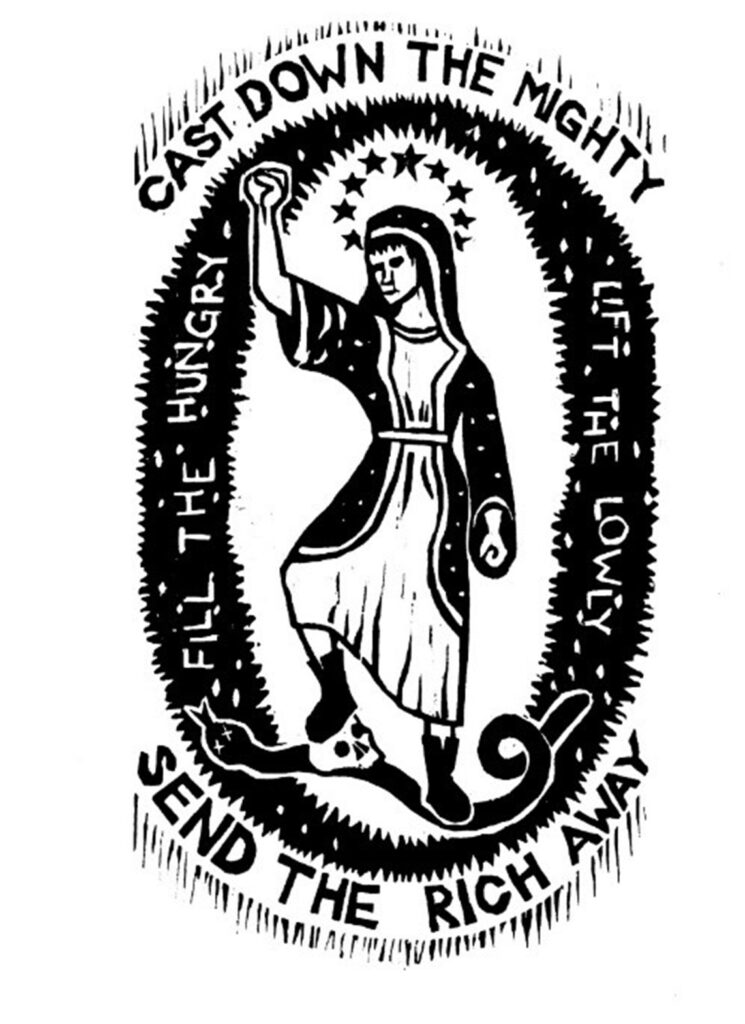
Imagine, then, the girl in the pageant, kneeling by the manger with her hands together in prayer. What would happen if she stood up, threw back her light blue shawl, raised a fist, stomped her foot to get our attention, and shouted out the Magnificat.
Pictured right is artist Ben Wildflower’s depiction of Mary speaking the words of the Magnificat. This piece appeared in the Washington Post, 20.12.2018. THAT girl would be the Mary of Luke’s gospel!
Revd David Carpenter
Lecturer
November in Pictures
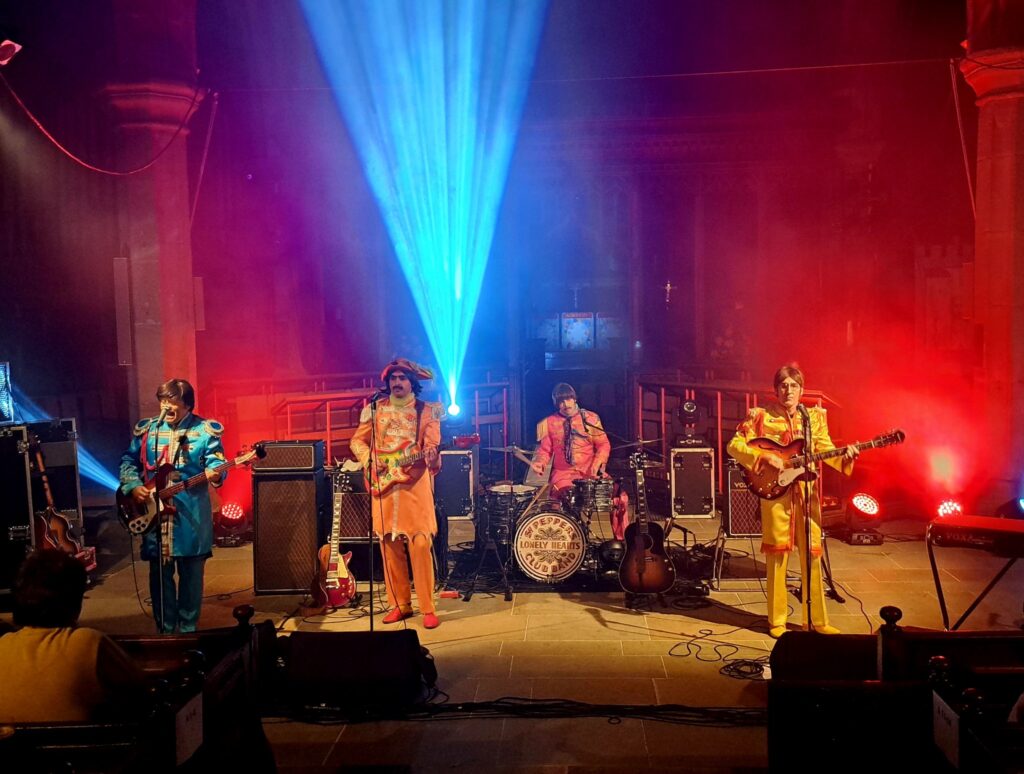
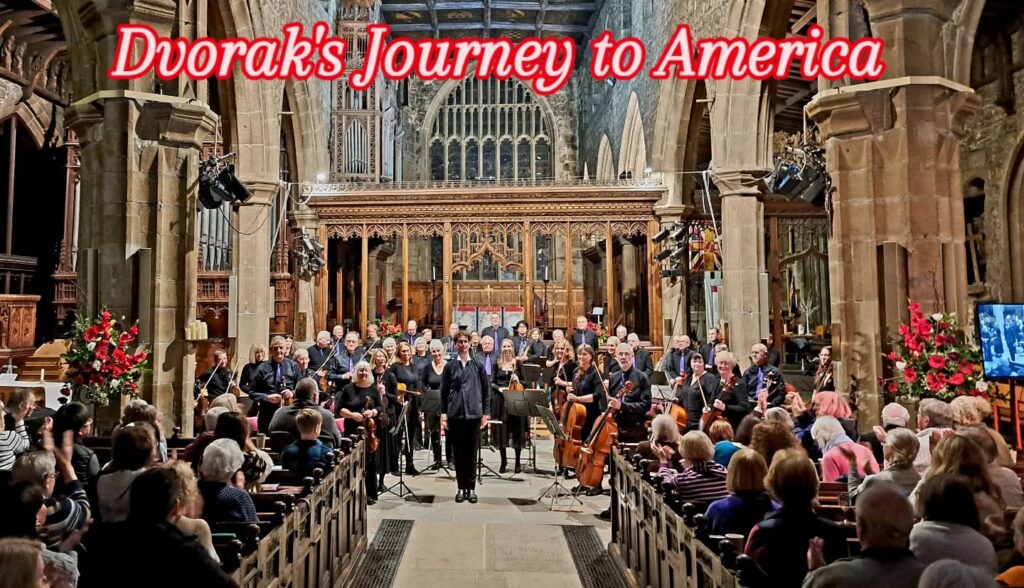
November was a month of concerts. Pictured above is the Queen tribute night. There was also tributes to Coldplay and ABBA, a pre-Christmas Wassail, Durufle Requiem, Faure Requiem, and the Halifax Symphony Orchestra performed an all Dvorak programme, pictured below. Concerts are all promoted on the Events Page. Tickets for all concerts are available via our website and most are sold in the Minster shop.
MU @ the Minster welcomed other Mother’s Union branch members to the annual ‘Rise Up!’ service to raise awareness of the issues around Domestic Violence.
November is the month of Remembrance Sunday. It was marked at the first Fashion Show hosted by the Minster organised by UpNorth Runway.
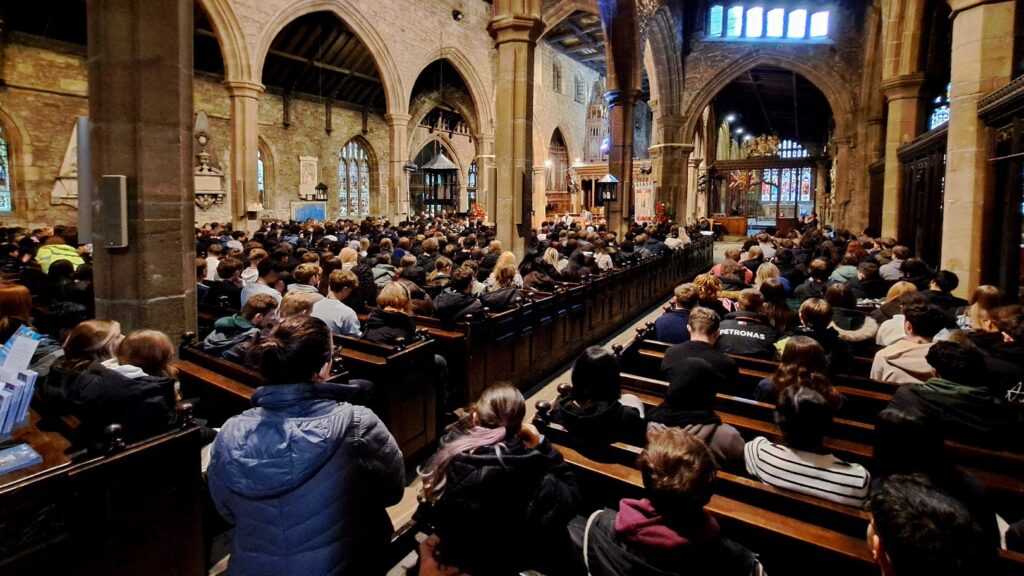
The Calderdale community gathered at the Cenotaph in Duffy’s Park, followed by the Civic Service in the Minster. On Remembrance Day itself around a thousand staff and students from the Trinity Academy Sixth Form again held their assembly in the Minster, pictured bottom.
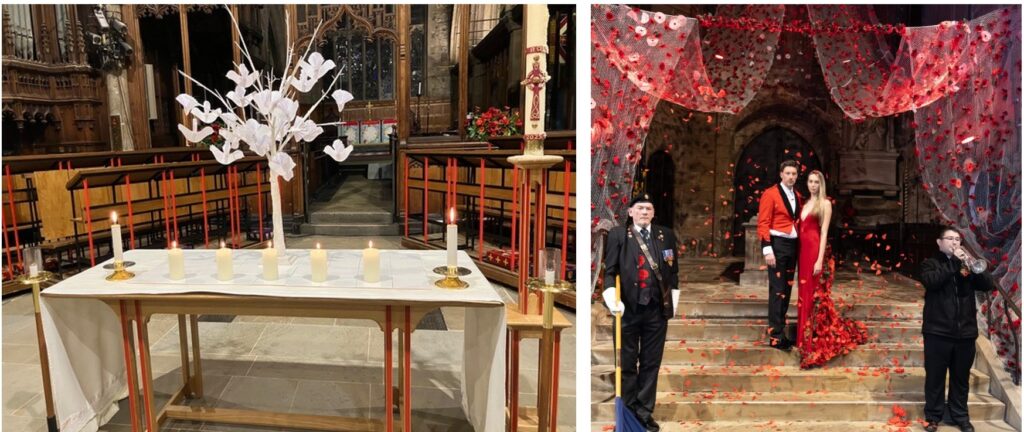
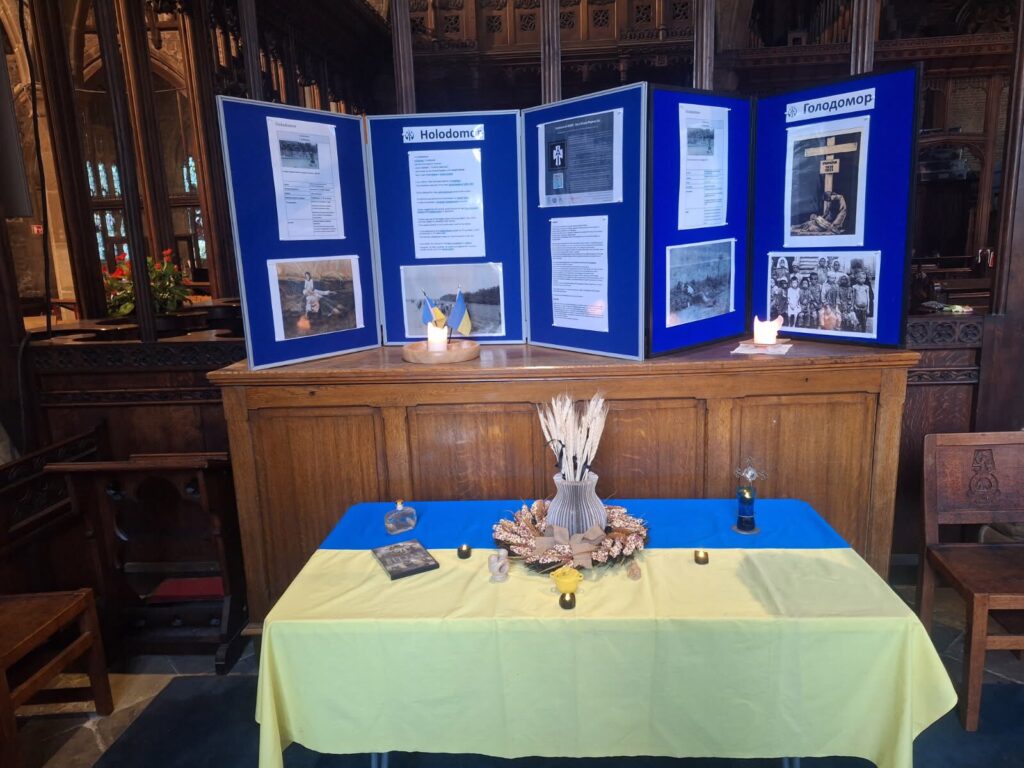
Halifax’s Ukrainian community used the Minster to commemorate Holodomor, the systematic starvation of the 7 million Ukrainians by Russia in 1932-3.
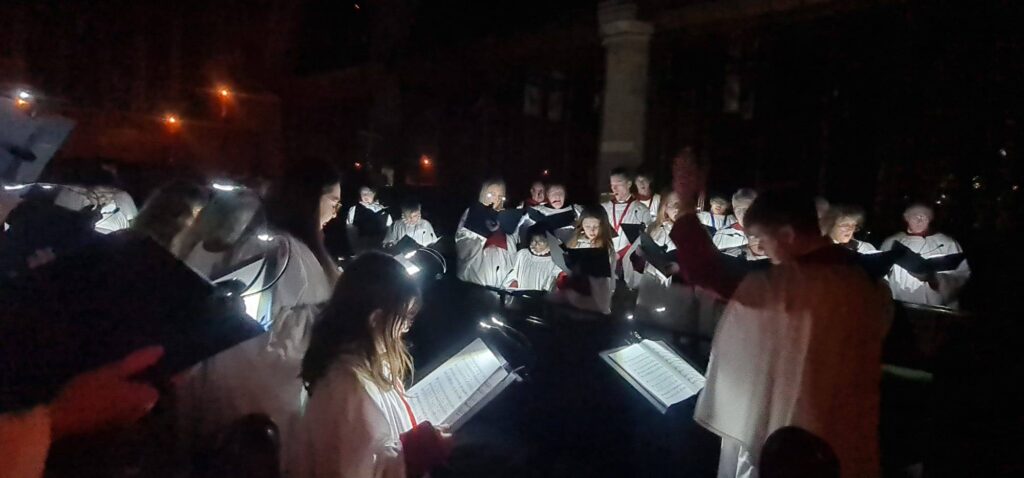
November ended on Advent Sunday with our traditional Carol Service and Procession and Overgate Hospice’s ‘Light Up A Life’ Service.
Parishioner Profile
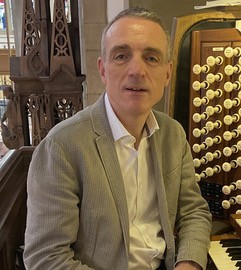
Name: Sean Montgomery
Favourite colour: Blue — according to a quick Google search, Blue suggests I’m a sensitive and reliable sort who tries to think of others, values stability and likes to keep a tidy home. I’m not entirely sure about all of it, but the last part definitely rings true!
Favourite music: A tough one! Good music is good music, whatever the style. If it’s done well and played with heart, I’ll enjoy it, whether that’s an organ voluntary or a great pop track.
Favourite place: There’s nothing quite like listening to evensong in a cathedral—the stillness, the sound, and the architecture together create space to think, breathe, and be inspired.
Favourite food: Anything my partner Annette makes. Annette can make a tasty meal out of thin air – I am very lucky!
Thing most proud of: Keeping family and work more or less in balance—and the organ playing just about up to standard!
Work life: I have always been fascinated by electronic music, and after leaving the Royal Academy of Music in 1986—where I studied organ and composition—I worked briefly as a tape transfer and mastering engineer at EMI Records before joining Roland Corporation, one of the world’s leading manufacturers of electronic musical instruments. You’ll often see our gear used by artists on television, in studios, and on stage around the world. I began in a sales role but soon discovered a passion for connecting the needs of musicians with the people designing the instruments they use. That path led me into product marketing, a role that ensures that what we create truly meets the expectations and needs of those who make music. Today, I lead a global product marketing team, working across borders with engineers, designers, and artists to develop instruments that inspire musicians everywhere. It’s a rewarding role that’s taken me to many countries, collaborating with performers from every style and background—strengthening my belief that music, whatever its form, brings people together.
100-word bio: Born in Middlesex, West London, I began picking out hymns on the family piano after church before starting piano lessons at five and organ as a teenager. A specialist music course in Andover led to studies with Richard Seal at Salisbury Cathedral and then to the Royal Academy of Music. Shortly after joining Roland, I moved to Wolverhampton for five years, followed by Leamington Spa, where I became organist of All Saints Parish Church—a former organist there, Neil Wade, also went on to Halifax Minster! A brief period in Abergavenny, Wales, then brought me to West Yorkshire, where I’ve spent the last decade living with my wonderful partner Annette. My involvement with Halifax Minster keeps me close to the classical and choral traditions that first inspired me, while my work as a trustee of Calderdale Music helps students discover the many paths a career in music can take. Blessed with two daughters—Kathryn and Niamh, who is now pursuing musical theatre—I’m lucky to have music in every part of my life.


